Friday, 28 October 2022

I am not a fan of creating a "Profound Autism" category. Here's why.


Photo of a child with blonde hair. Over the photo is written the word Profound, in black against a red rectangular background

Fairly regularly, we get a few well-connected parents demanding that their autistic child be given a 'profound autism' label.  They often claim that their child cannot communicate at all, and that their child lives in fairly permanent distress solely because of being autistic.  

They reason that the moment their child has this word Profound attached to their file, their lives will be transformed.

Oddly, the same parents describe their child's actual list of difficulties.  These often include, on the lists...


Not having their communication enabled.

Extremely high anxiety levels.

An intellectual disability.

Epilepsy.

For some reason, some professional told the parent that those things are 'profound autism', and they are completely convinced that their child cannot access proper support for any of those things without the word Profound in the file.

It's very strange, isn't it.

And it's not accurate.  At all. 

It's vital that each child gets tailored support. This is easily achieved, in theory, by writing down the correct things on their file, as well as fully respecting them as a human being and fully respecting the warm, loving and caring relationships they need to thrive.  If they need communication support, they should have that.  If they need sensory accommodations, they should get those.  If they have an actual medical condition such as epilepsy, of course they should have appropriate medical support.  If they are in such distress that they are self-harming, absolutely we should investigate the cause of the distress and lessen it.  

We should improve their quality of life and improve their communication methods so they can partner with us in finding their own best ways forward.  And yes, I mean enabling the communication of all children.  All children can communicate.  Not all do using words. We need to be skilled in understanding what they are communicating, and skilled in understanding that autistic communication is often different.

My concerns about the thinking are more than just bafflement about the alleged magic of the word Profound, though.

Regularly, those of us who work in the field of autism, as researchers, lecturers and advisers, encounter some rogue individuals and teams.  A subgroup of people who enjoy finding children who are believed not to be able to communicate, ones who are believed to be 'too disabled' to speak out about what's done to them. We don't have to go far to find horrific media reports on what happens.  Not everyone is a pleasant individual with a child's best interests at heart.  You don't want to know the statistics on how many children's organisations have predators in their midst.  The word 'profound' doesn't guard against this.  It may make the situation worse.

When I attend care settings to advise on a child or young person with higher support needs, what I need is an accurate summary on the file.  For example: (fictional)

"This is Sam.  Sam is 7 years old and likes spending time with her pet dog, and with her brother and Dad.  Sam loves the colour blue and enjoys watching cartoons with people she trusts.  Sam gets on very well with person x and person y here, and uses communication system x to let people know what she needs. (Further details on Sam's strengths and joys).

Sam is autistic, enjoying a predictable routine and really clear instructions.  Sam also has an intellectual disability meaning that (examples) .  Sam is having treatment for epilepsy, and has sensory needs which include deep pressure from (e.g. weighted blanket etc) and avoiding sudden loud noise. See the full OT report in Appendix 2 which details the sensory accommodations needed. 

If Sam is starting to be distressed, she may do X, or Y and then benefits from seeking a quiet space with a trusted person with her and toys A and B. If Sam cannot regulate and becomes more distressed, this is the list of safe, respectful ways we work with Sam to help her regulate and recover...(list)"

I'm now getting a really good idea about Sam as a young person to be respected. Sam as a fellow human being. Sam's strengths, interests and joys.  Sam's loved people and relationships.   Sam having agency in their lives.  Sam having an accurate list of how their brain best works, and what sort of medical and communication/sensory needs they benefit from.  I now have something I can use to help evaluate how well we are meeting Sam's needs, so that we can all work together - Sam,  team, family, our advisers, to improve things still further.  It's collaborative, positive, respectful and  - at all times - considering Sam's human rights.  The team around Sam is picked to be caring, responsible, enabling, able to build trusted relationships, calm and friendly. If they make an error, they want to learn from it.

Such places exist.  Such files notes exist. The young people in such settings have a life where they can thrive.

There is no part of that process that is improved by slapping the word PROFOUND on the front of the file.

Thank you for reading.   


Tuesday, 14 June 2022

Research that dishonours and harms autistic people


A picture of a diverse group of people. The word ERASED is written across it.

This week, thousands of autistic people witnessed a research team describing us as risks, as deficits, as disordered.   Parents of our loved children and young people were described as "Parents of ASD cases".  The research team were very excited to write this research paper, they explained.

The autistic communities received this series of violent, humiliating words,  this dishonouring and dehumanising - and they said it hurts.  They said please stop it.  Some said stronger things.

And it was met with silence.

The team from a top University chose to interact only with people telling them how wonderful their research was.

There's something very, very wrong, isn't there.

Ethics is a vital part of research.  It is about ensuring we do no harm to those we serve.

As researchers, teams are there to serve the autistic communities.  Not to hurt and insult them.

Autistic people are not there to serve researchers as a convenient sample or a way to advance their careers.

I'm part of these communities.  As a proud parent of a fantastic autistic son.  As an autistic person myself.  As a researcher.  As a consultant and lecturer in this field, including to the NHS in various roles.

I am so sad to see some research teams behaving in these frankly callous ways.  I wish the example above was rare.  It is not.

Every day, for me, it is such an honour to do what I can to uphold the lovely autistic people I am delighted to share life with.  My family, my friends, my colleagues, the general autistic public on social media.  Their honesty, integrity, determination, courage and friendship are worth more than words can say.

We are not "ASD cases".  

We are your friends. We are your research colleagues.  We are your neighbours.  We are your fellow NHS workers.  We are artists, and musicians.  We are faith leaders and authors.  We are parents and grandparents, brothers and sisters.

We are worth every bit as much as every other human on this planet.  Our way of interacting, our emerging cultures and ways of being, are worth their place.  

Those that need support have been asking for things that actually matter to us.  There is more research than you could shake a journal at, on this subject. Instead, we get paper after paper describing us like we're some form of disease to be eradicated.

I won't despair of research, as I see so many good people emerging.  People who put us front and centre of research into our own lives.  People who treat us as valued colleagues.  As equals, not as laboratory specimens.  People who are our allies.  People who are autistic and working at the top levels of new thinking, new theories, new understandings.  I am honoured to work with several such teams.

I would very much like some researchers to stop hiding behind one another, and behind dehumanising words.  To have the courage to re-evaluate their thinking and their beliefs.  To have the curiosity to read those new narratives, to meet autistic teams and really collaborate, really understand.

If you cannot gaze upon us and see our worth, our love, our caring, our whole humanity, this is not the field you should be in.

This is our future.  Our lives.  Our present.  Our history.  Our community.

You are not called to erase us, as researchers.

You are called to earn our trust, and share in our future, with love. 


Thursday, 3 February 2022

Transforming our understanding of autistic people - Perception of Pain & Distress in Others


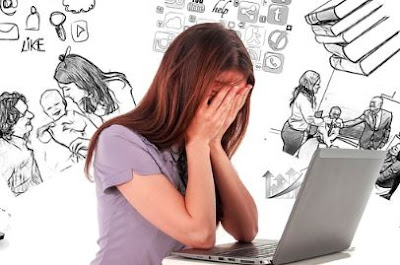
A woman with long hair, sitting at a laptop with her hands over her eyes, in apparent distress

In February 2022, a new publication was released for Criminal Justice teams, in the UK.

"Achieving best evidence in Criminal Proceedings: Guidance on Interviewing Victims and Witnesses, and Guidance on Using Special Measures".

In it, a stark and concerning misdescription of autistic people, in my view: (page 38).

"...witnesses with autistic spectrum disorder..are likely to have little understanding of the emotional pain or problems of others..."

Certainly, in the 1940s, that was one of the original misunderstandings about autistic people.

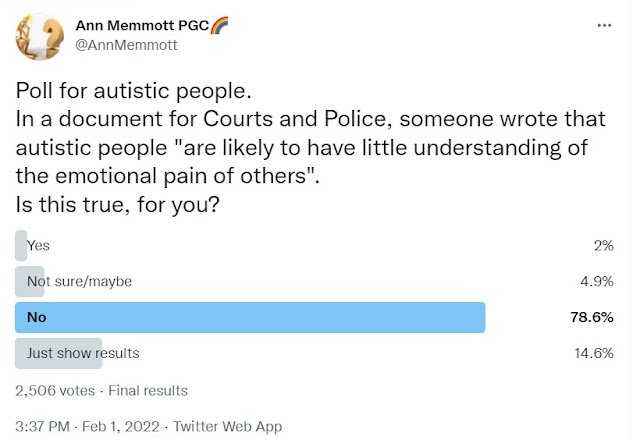
Let's look at an up to date informal poll result, asking autistic people if they felt this was true, for them.  

The poll, described in the text

There were more than 2500 people interacting with the poll.  Some just wanted to see the results.  That leaves us with just over 2000 autistic people giving answers.

50 of those said yes, they felt they had little understanding of the emotional pain of others.

1,970 autistic people said no, this was not true, for them.

I'll repeat that:  1,970 autistic people responding to this informal Twitter poll said no, it is not true that they have little to no understanding of the emotional pain of others.

If this poll isn't good enough evidence to question that statement, I would direct people to endless personal accounts visible online. Endless blogs. Endless books authored by autistic people. Endless online videos. We can have all manner of academic debates about whether an informal Twitter poll is reflective of the wider autistic population.  That's not the point, here, though.  The point is, if that statement in that criminal justice paper is true, how on earth did we end up with this poll result?  Twitter isn't a hidden backwater.  It's a public social media platform.

For decade after painful decade, autistic people's actual voices and lives haven't been relevant.  Instead of asking autistic people, we've delved into ancient texts, as if we are following some ancient religion instead of dealing with real live people, right in front of us.  And it concerns me greatly. 

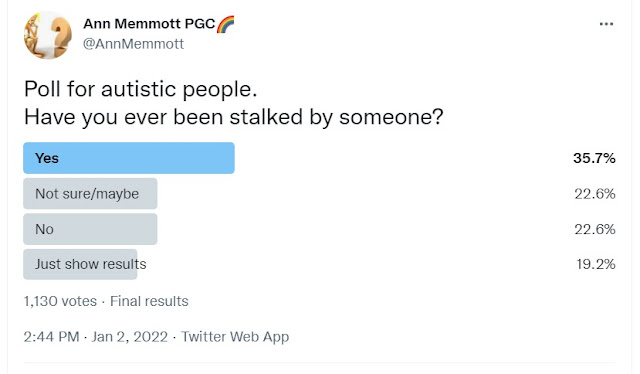
What else concerns me? The number of autistic victims of crime.  Here's another informal Twitter poll.  

Twitter poll of results around autistic victims of stalking

"Poll for autistic people.  Have you ever been stalked by someone?".
The majority responding said yes. Big numbers responding again.

We can have another academic debate about whether the percentages reflect the whole autistic population.  Or we can take a step back, sit on our egos, and say, "Oh heck, there are hundreds of autistic people who have been victims of stalking and We Had No Idea Until Now."  We hadn't even been asking these questions.  Across the world, millions of autistic people who are victims of crime, and we know almost nothing about them.

I'd like us to reflect carefully on the message we're giving to Courts and others in the Criminal Justice System here in the UK:  That autistic people can't feel the pain of others?   Do we think this is how we achieve justice for autistic people?  

I would suggest that telling Judges, Juries and Magistrates that we probably can't feel the pain of others is likely to prejudice the quest for justice for us.  It's simply untrue in most instances, and it's extraordinary to find it in a brand new document for something this important.  Autistic people usually feel deeply.  We usually hurt deeply.  We usually care deeply.  Exceptions will apply, as is the case for all humans on the planet.  No Criminal Justice proceeding should start with the untrue premise that the marginalised group are generally unfeeling.  Would it have potential to lead a Jury, for example, to believe the crime against us wasn't that serious, as we can't feel much anyway?  One can only hope not.  But, why say something like this at all?

May I strongly recommend that, when we are writing documents about marginalised people, we include a good number of representatives of different groups in those communities, a good number of academics & others with expertise from those communities, and we get it right?

This isn't the mid 1940s any more, and we cannot simply keep repeating old myths at new audiences.  Autistic lives are as precious, as fully worthwhile, as the lives of everyone else.  Justice is already out of reach of most.  Goodness me, as a victim of crime myself, such a statement portraying me as an unfeeling entity would put me off approaching Police or a Court at all.  It's dreadful.

Autistic people deserve our respect, our accuracy, and our humility in listening to them. Autistic individuals are fully worthwhile people who usually feel deeply for others, are usually victims of crime, and are too often forced to live appalling lives littered with horrifying myths from the past.

Let's do better than this, please.

Thank you for reading.


Tuesday, 30 November 2021

Useful New Autism Info for Care Settings


This is a list of useful research papers and Commissioned documents that have changed how we think about autistic people, and how we respond to their distress, co-occurring conditions and their brain events.

https://www.ndti.org.uk/resources/publication/its-not-rocket-science  is a commissioned report by young autistic people, on easy ways to make wards and care settings into sensory-friendly spaces.  Lots of useful new information on the sensory needs of autistic people, and the social communication needs.

https://www.local.gov.uk/our-support/sector-support-offer/care-and-health-improvement/autistic-and-learning-disabilities/autistic/considering-and-meeting-sensory-needs-autistic-people-housing is a commissioned paper from the Local Government Association on how to ensure really good housing for autistic people.  

https://www.waterstones.com/book/avoiding-anxiety-in-autistic-children/luke-beardon/9781529394764  is an example of an excellent up to date and accessible book about how to avoid anxiety for autistic children.  Dr Luke Beardon has written other books for different age groups and situations, equally recommended.  Other booksellers are available.

https://onlinelibrary.wiley.com/doi/full/10.1002/aur.2306 is a new paper looking at the huge number of autistic people who experience diagnosable trauma from 'traditional' and other events, including bullying.  It changes how we think about 'behaviour'.

https://www.peacepathway.org/ Potentially useful information about autistic people and difficulties with food/eating.


https://www.jpma.org.pk/PdfDownload/10585 The newer research into autism and hypermobility/EDS, suggesting more than half of autistic people may have one of the forms of hypermobility, which can lead to or include exhaustion, movement difficulties, POTS (potentially causing collapse), and pain.

Saturday, 20 November 2021

Strengths-Based Approaches for Autistic Individuals


A picture of a person wearing headphones.  They have dark hair and are smiling.  The background is rainbow-coloured.

For many years, people assumed quality of life for autistic people only happened when we were 'normalised' from an early age.  This 'Early Behaviour Intervention' usually focused on improving our allegedly weak areas, and enforcing this improvement for many hours a week.

An informal Twitter poll asking autistic people if being made to use eye contact has improved their lives.  Most said a clear 'no'.

There is very little evidence of this approach leading to a better quality of life.  The informal poll shown above is a clue.  Hundreds of votes.  Did all that 'you must make eye contact' training lead to a better quality of life for them?  Hardly anyone said yes.
Below, another informal poll, again with hundreds of votes.  What about wider social skills training for us?  Did it improve our quality of life?  Hardly anyone said yes.

It's useful to ask people if something helps, isn't it.

Another informal Twitter poll asking if it helped quality of life to have our social skills normalised.  Most people said a clear no.


There is growing evidence of weakness-based approaches such as ABA leading to poor self esteem and sometimes catastrophic outcomes. Other of my blogs discuss these. This isn't difficult to understand.  In the same way, if you were described as a list of problems that had to be solved, every day of your life, you might feel depressed, anxious and exhausted.


A strengths-based approach, building on things we are good at, has an increasing fan base, amongst Professionals as well as autistic people.

There are a lot of good research papers that may help with our thinking.

Here are a few of them:


It is an important discussion for all of us to have.

How is a team going to build on my fantastic young person's strengths, as well as supporting them in any area where they need that support?

How can their hobbies and interests be a source of relaxation and joy to them, not a thing used by teams to enforce normalisation?

How can we appreciate diversity, and work collaboratively with autistic people to understand autistic culture and communication?

There are so many useful things to keep exploring, and so many more positive outcomes to be discovered.

I am grateful, as ever, for teams who are promoting this strengths-based, positive approach, and who refuse to use the negative, 'deficit and disorder' thinking of the past.

I would like every autistic individual to be safe to live their best, authentic lives, able to thrive as themselves, not as a copy of someone else.  That's a Human Rights approach, and a caring approach.  I commend it to all.

Wednesday, 20 October 2021

What is autism? A modern understanding for 2021

A photo of a woman with blonde hair. She is wearing a grey jacket and white top. Above her head are question marks.  She looks quizzical.
What is autism?

We get asked this a lot.

There's been quite a battle going on.  I will generalise:

Group one... fans of two men who thought they'd invented it in the 1940s, and who were completely convinced that autistic people were broken versions of other people.  Young boys with strange behaviour...maybe an occasional young girl.  No empathy, repetitive meaningless behaviour, resistance to change, no interest in other people.

It didn't matter that autism was well described by a woman, years beforehand.  The men got the acclaim for this supposed discovery.

It was important to put autistic people into 'mental hospitals', describing them in entirely negative language like deficit, disorder, obsessive, etc.  It was important to stop their 'behaviour' by enforcing normalisation, because this was believed to be better for us.

We were too-often experimented upon as if we lacked opinions, feelings, insight, pain responses or human rights. 

No progress was made.  But they just had to keep on doing these things, convinced that at any moment, they were going to prove that there was some fix, some cure, some pill, potion, lotion, electric shock, operation or genetic wizadry that would remove autism.

Nothing worked.  Well, some autistic people were forced to do repetitive things, and others were forced to sit really still and be really quiet.  This was called a success.  Mmm.

Group two... the autistic researchers, academics, specialists and our allies.  The rise of the neurodiversity movement. 

We want human rights for all autistic people.

We want every autistic person to thrive as their own best version of themselves, not a fake copy of someone else.

We appreciate autistic communication as a genuinely different way to socialise with one another.  No, really.  See research links below.

We appreciate the deep focus that autistic people have for their specialist interests, their hobbies and perhaps future careers.

We see autism as a largely sensory condition, in which our brains take in too much information in busy, noisy places.  Too much from flickering light and loud sound.  Too much from odours and rough textures.  Too much from noisy chattering.  So we respect those who need quieter, better spaces.

We want every autistic person to have excellent support, whatever their level of support needs.  Truly person-centred.

We want every autistic person to have excellent healthcare, whatever their communication needs.  That worryingly low average age of death has to change.

We want all families to feel supported and valued also.

We want to leave negative language about us in the past, where it belongs.  Stigmatising language has done such damage. None of it is necessary. Not for alleged 'treatment' or for anything else.

In line with the National Autistic Society and the Parliamentary Reports, we want autistic people to be freed from inappropriate hospital placements and given proper, safe community homes where they can belong.  Where they can thrive.  Where they can flourish as themselves, amongst those they choose and whom they trust.

We know that so many autistic people are still to be discovered, thanks to those old myths about it.  Autistic females, Black individuals, Asian individuals, older individuals.  So many different groups who were left out of diagnosis, denied diagnosis. 

So many who have found better self-understanding through realising they are autistic.  Better chances of finding places that suit their needs, now they understand those needs.  Better chances of finding good relationships, now they understand how they communicate and how they can thrive.

A diagnosis should never be a pathway to a locked door, normalisation-enforcement and a daily list of negative words and low expectations.

A diagnosis should be a pathway to thriving and to meaningful access to everyday things, in the same way as others expect.

Time to leave the past where it belongs, and gather round our autistic loved ones with new appreciation, and new hope for the future.

Thank you for reading.


Want more info and  research on the above?  Sure - go to 

http://annsautism.blogspot.com/2019/01/autism-some-vital-research-links.html as a good starting point.  Using that as your starting point, lLook up the best respected autistic academics and our allies, and read what they write.  Get the books by Dr Luke Beardon, for example. Look at the outputs from the autistic-led research conferences that happen regularly through the year.  Ask us.


Saturday, 25 September 2021

Autism is not a look or a behaviour. About enforcing 'Masking'.


A drawing of a boy who is smiling. He has brown hair and a yellow shirt
In the press, news that a team have found a way to give fewer diagnoses to autistic children.

"Autism therapy aimed at infants may reduce likelihood of later diagnosis: Study suggests tailored therapy could help some children develop social skills before school age", reads the headline in the Guardian newspaper for example (20 September 2021).

The alleged therapy appears to be based on ignoring a young child if they behave autistically, or giving them a 'time out' for doing so.  Parents are taught to reward any behaviour that matches non-autistic social skills, such as eye contact, waving when someone else waves, etc.  The end result is to deliver to the parent one child who appears normal and can make eye contact.  Like the picture at the top.

"This is the first worldwide evidence that a pre-emptive intervention can reduce autism behaviours and the likelihood of a later diagnosis,” said Prof Jonathan Green at the University of Manchester, breathless with excitement.  OK, I may have added the 'breathless with excitement' bit.  But that's the general tone of the Press - that if we can 'reduce autism behaviours' we can stop the autistic children getting a diagnosis, and isn't that fantastic!

OK.  Reality check.  I asked autistic people if they had stopped being autistic, once they learned to do eye contact, waving, etc.


An informal Twitter poll as described in the text

That's odd, isn't it.  There's over 1000 votes.  Hardly more than a handful thought that doing those things means they're now cured of autism.  No, they'd still be autistic.

So what on earth is going on?  Other Press articles suggest that perhaps they wouldn't develop 'full blown autism' if they learned to hide being autistic.  What? Is that even supposed to make sense?  There's not even a diagnostic category of 'full blown autism'.  We're either autistic, or we're not.

There are so many problems with this allegedly exciting new research, I and other professionals barely know where to begin.

Autism is not a 'look'.  It is not a 'behaviour'.  It is a different neurology and we are born with it, from all the evidence to hand.

Training autistic children to appear nonautistic is called training them to 'mask' or 'camouflage' their natural and normal behaviour, and replace it with inauthentic, exhausting mimicking of others, all day, every day.  

The end result of that is not happiness.   It is misery.  Misery to such a degree that we now know from research that there are links to suicide. Reference and so many more modern research papers can be found in http://annsautism.blogspot.com/2019/01/autism-some-vital-research-links.html

Brand new research details the narratives around how 'masking' leads to autistic burnout and other mental health crises. Here's the link to the article, which also discusses the other awful outcomes of enforced normalisation:  Autistic burnout

So, our triumph is to stop autistic children being diagnosed, is it?  Getting help and support, finding their peers, learning who they are?  That's good, is it?
Because autism is some terrible thing that needs hiding, is it?
Who says so?

For sure some autistic people have a tough life, with multiple difficulties. A life that needs a lot of support. A life that may need medical assistance for actual medical situations such as epilepsy, or pain/mobility conditions such as Ehlers Danlos (both of which can co-exist in autistic people).  But in what way is preventing a diagnosis a fantastic idea?  So we can fail to support them?  So we can make them exhausted from masking as well as struggling?

This is recklessness, not triumph.  It's wrecking children's lives.

And it has no place in a modern society.

The Medical Professions are tasked to do no harm.  To put the rights of the child at the forefront of their thinking.  To uphold Human Rights legislation such as the Convention on the Rights of Persons with Disabilities (CRPD) which says that autistic children have the right to their autistic identity.  I'm not sure people even read that document, let alone uphold the very principles our Country signed up to.

Condemning young children to a life of poor outcomes, so others can be pleased that they 'look normal' or don't have 'full blown autism' (the sort where we are visibly autistic, shock!)  is an act of terrible cruelty, and I suggest that we never, ever do it again.

Thank you for reading.