Monday, 22 January 2024

Why is Brand New ABA still relying on evidence from these methods?


A photograph of a padded cell


On social media, I am often told that Applied Behaviour Analysis is now kind, ethical, considers potential harms, and seeks consent or assent from all participants.  I am also often told that it does not use punishments on autistic individuals (or indeed other people).

Oddly, the evidence doesn't support this positive view.

Today, for example, this paper appeared in the research journal lists.  It's from the Applied Behaviour Analysis (ABA) industry.  


In it, the researchers search for good ways to stop 'extinction bursts' from the children.  In other words, where a child fights back against the ABA team and continues to do the alleged 'bad behaviour', sometimes getting much worse before the child gives up and complies with the team.

The team set out a lot of very troubling information.

The children are as young as three years old.

There appears to be no mention of the children giving their assent to any of this, or how they would signal a lack of assent.

There is no discussion of the ethics of what the team is doing.

There is no mention of considering potential harms or adverse effects from ABA, nor discussion of how the original teams did any follow-up to find out if their alleged treatment 'worked'.

The 'bad behaviour' included trying to escape from the padded cells (no, you're not imagining this - that's where the 'treatment' takes place).  Or, falling on the floor, which could be a form of epilepsy, or a motor co-ordination difficulty, not a behaviour.  Or saying anything the team didn't like.  Or trying to take items of clothing off, which might be a sensory pain situation for the child. 

We are told that the children had this 'treatment' for 6 hrs a day, 5 days a week, for example.

The paper makes a lot of mention of punishers given to the children to force compliance from them.

It's hidden behind a paywall, like most ABA research.

Now, I am sure there will be some who say, "But Ann, this is based on older research.  We don't do this stuff now, honest guv".

But, this is brand new research.  And, if the ABA industry doesn't do this stuff now, where are the team discussing how they don't do this now?  Where is their ethical consideration?  Where is their denouncement of the punishers and the padded cell and the endless compliance-training to stop children from trying to escape this (in my view) living nightmare?  Where is the consideration of consent/assent and how meaningful it is if a child fighting, trying to escape or shouting is all seen as 'noncompliance' and not as 'a child saying no to this treatment'?

Is this brand new ABA?  Or is this yet another endorsement of the very same ABA it's always been?

We need to move on from the 1980s.  This wasn't fit for purpose then, and it's not fit for purpose now, in my view.  

I'll leave you to have a look at the external research on ABA, which can't even find evidence of it doing anything much to 'improve' the behaviour it sets out to 'improve', except in the very short term when stared at by the compliance team. Plenty in this blog.  Plenty on X, where I discuss the ABA findings regularly.

If you are in a position to rethink the 'therapy' your child is having, please do.  There are better, kinder, modern, collaborative, ethical, consensual approaches that enable real progress.  Ask the autistic communities about them.  

Leave this in the past, where it belongs.

Thank you for reading.   

Friday, 8 December 2023

Time to move on from last century? How to reframe diagnostic criteria for autism?


Silhouettes of the head and shoulders of people, in different colours.

The first autism research was arguably carried out nearly 100 years ago, by Grunya Sukhareva (1926). https://www.ncbi.nlm.nih.gov/pmc/articles/PMC5696677/  Later, autism was redescribed by others.


Since then, research teams and publications have often laboriously copied out those initial misunderstandings about autism.  They appear in text after text, paper after paper.  And, arguably, diagnostic manual after diagnostic manual.

Research in the last few years has uncovered a veritable treasure trove of new information about autistic people.  About autistic diversity, about strengths as well as areas needing support, about honesty and integrity, and so much more. We know so much more, also, about autistic sensory differences, social communication differences and strengths, and the ways that society benefits from each and every one of us.  The field has expanded from a niche medicalised 'disorder' to a wealth and depth of nuanced, thought-provoking information, stretching throughout contributions to arts, philosophies, humanities, literature, faith & spirituality, and so much more.  

The diagnostic texts continue to lag behind. An example can be found at https://www.cdc.gov/ncbddd/autism/hcp-dsm.html and shows us as a relentlessly long list of deficits.  Not a hint of modern research has touched its pages as yet, it would appear.  Nor is there a hint of the contributions that some autistic people have made to our society.  In research paper after paper, we appear only as burdens on society, as things to be cured, and sometimes, horrifyingly, as some object that is barely human.   What a disaster.

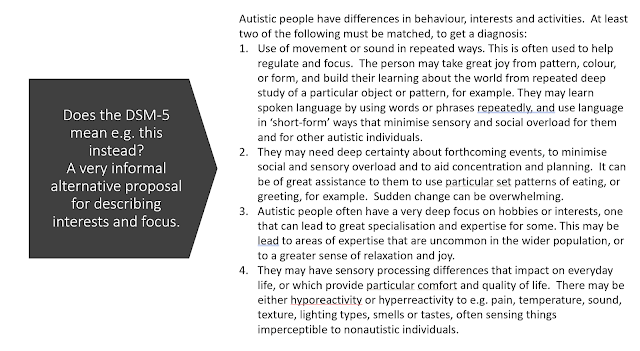
So, what would diagnosis look like, if we put in the newer research?  I've spent decades amongst so many hundreds and thousands of fantastic autistic people, discussing this.  The slides below are informal, based on those many discussions and on the newer research, much of which is linked at https://annsautism.blogspot.com/2019/01/autism-some-vital-research-links.html.  The pictures below are ones I use as my own 'thinking points'.  But they serve a purpose, as a discussion-point for us all.

There's an old saying - that if you keep doing the same thing, and it keeps going wrong, something needs to change.  Well, we've spent 100 years breaking too many autistic people with the crushing load of total negativity, every day of their lives.  Can we change the narrative and learn to rebuild some lives instead?

I put it to the diagnostic communities that they are wise to work collaboratively with autistic people of all kinds, and read the modern research information thoroughly.  Especially that which shows so clearly that every autistic person benefits from a more positive, kind, respectful framing of our differences, and our support needs.

I'll look forward to discussing things further, on social media elsewhere.


Autistic people must match each of these three areas of social communication difference, and also at least two out of four types of focused behaviour: [not shown on this slide]  a) Differences, throughout life, in social communication and social interaction across multiple contexts: Differences in social approaches, often with longer information-giving rather than back-and-forth conversations.  Social ‘chit-chat’ is often minimised or absent, to avoid social and sensory overload. Differences in body language, face expression and use of eye contact. Often eye contact is sparse or non-existent, again avoiding social or sensory overload and often enabling better listening.  Differences in relationship development, for example commonly enjoying friendship and relationships with some other autistic individuals, but finding it very difficult to adjust to nonautistic ways of expressing friendship and relationships.  Misunderstandings from nonautistic indivduals are often common and there may be a long history of experiencing anger or ostracism from others, seemingly for no reason the autistic person can discern.


Autistic people have differences in behaviour, interests and activities.  At least two of the following must be matched, to get a diagnosis: Use of movement or sound in repeated ways. This is often used to help regulate and focus.  The person may take great joy from pattern, colour, or form, and build their learning about the world from repeated deep study of a particular object or pattern, for example. They may learn spoken language by using words or phrases repeatedly, and use language in ‘short-form’ ways that minimise sensory and social overload for them and for other autistic individuals. They may need deep certainty about forthcoming events, to minimise social and sensory overload and to aid concentration and planning.  It can be of great assistance to them to use particular set patterns of eating, or greeting, for example.  Sudden change can be overwhelming. Autistic people often have a very deep focus on hobbies or interests, one that can lead to great specialisation and expertise for some. This may be lead to areas of expertise that are uncommon in the wider population, or to a greater sense of relaxation and joy. They may have sensory processing differences that impact on everyday life, or which provide particular comfort and quality of life.  There may be either hyporeactivity or hyperreactivity to e.g. pain, temperature, sound, texture, lighting types, smells or tastes, often sensing things imperceptible to nonautistic individuals.


Monday, 31 July 2023

When almost all movement or sound is called 'Challenging Behaviour' if you're autistic


A person wearing a t shirt and shorts, standing on a stone pier, looking out over a lake towards mountains

In some of my roles for organisations, I'm commissioned to review research papers about autistic people.

Some of the findings are startling, and not always in a good way.

In recent days, one paper in particular got my attention.  The researchers wanted to know if 'challenging behaviour', or 'problem behaviour' as it is sometimes known, increased or decreased with age, for autistic people. 

So, they looked at all sorts of studies that had been done on this.

Hardly any of them had considered autistic adults.  The assumption in nearly every one of them was that all autistic people are children.  So, nearly every measure of how 'challenging' autistic people are was done on children, not on adults.

They linked to a small number of papers that assessed adults.  Most were from years ago, out of date.  One was at least fairly recent, dating from 2016.  It was indeed looking at 'behaviour' of some autistic adults.  It used a scale that was invented in 1996, not far off 25 years ago.  The scale is called the SIB-R, although other out-of-date scales are available.

I began looking at the measures in that scale.  Remember, readers, these are for autistic adults, not toddlers or primary school children.  Here's some of the measures, which I shall put into everyday words:

Being too clingy.

Not doing as we are told.

Complaining.

Laughing without a good enough reason.

Crying without a good enough reason.

Interrupting without permission.

Rocking (in other words, normal autistic stimming)

Twirling their fingers (in other words, normally autistic stimming)

Talking to themselves.

Eating too much or too little.

Staring into space.  The person in the photo at the top of the page is staring into space.  Deeply challenging, eh?...

Being too worried.

Being sad.

Not able to concentrate.

Sleeping too much.

Being negative about themselves.

Standing too close to someone.

Talking what someone else feels is nonsense.

Burping.


Well, it's all enough to give anyone indigestion, in my view. 

In fact, the autistic adults can score pretty highly for 'challenging behaviour' from being able to tick off things on this list.  And teams are able to tell others that the autistic adults are in need of serious interventions and major treatments for their 'challenging behaviour' based on these sorts of humiliating, inappropriate, appalling lists.

What on earth is going on?

How is research still using any such measure, bringing it constantly back to the present day as if it is in some way meaningful as a gauge of our fellow human beings, behaving in perfectly ordinary human ways.  Or, behaving in ways that fully respect their autistic neurology and needs?

Are we servants, doing the bidding of nonautistic people, or adults with every right to our own autonomy, our own right to say 'no' and mean 'no'?   Whose power-trip is the above list, eh?

We have a duty and a responsibility to review past out-of-date questionnaires, and to refuse to base our knowledge of autistic people on meaningless measures, designed decades ago for children.

Work with autistic people to design meaningful measures of 'behaviour.  Measures that include distress, exhaustion, pain, trauma and other very real scenarios in too many autistic lives.  Measures that lead to greater understanding of the 'why' of why someone may do something more drastic, for example.

Too much of what passes for fact about autistic lives turns out to be based on stuff that was only true for toddlers,  or on measures that are so out of date they should be binned.  

No wonder we make so little progress in creating quality of life for the lovely autistic people in society, eh?

Thank you for reading. 


Saturday, 24 June 2023

"I don't like your tone"


A photo of a blonde woman staring angrily over her spectacles

Decades of life as an autistic person, living amongst hundreds of other lovely autistic people, has given me some insights.  One of these is how often many autistic people get told, "I don't like your tone" or "Why are you so angry" or "There's no need to be sarcastic", or similar. But, they weren't feeling anything negative at the time.  They had no intention of saying anything negative.  Somehow, many nonautistic people hear negativity/anger/sarcasm in autistic voice tones...or in our writing...when that's not what we meant. At all.

What's going on, eh?  Is this really common?

I did an informal Twitter poll.  Here's the results.


A poll result, described in the text

We had nearly 5,000 people taking part.  I asked them if they had ever been accused of being angry/aggressive /a bully/sarcastic, because of their voice tone, but they hadn't intended it to sound that way.   The vast majority said yes.  There was quite a discussion on the post also, with many saying it happens to them very often.  Some related disastrous consequences from some people mistaking their tone or style of writing for rudeness.

The thing is, autistic people communicate in a genuinely different way.  There's plenty of research on this.  For example:

http://annsautism.blogspot.com/2019/01/autism-some-vital-research-links.html allows you to search through for a lot of it.  

Ours is often a very direct, clear style.  We often use shortened sentences, or go straight into a topic.

But it's more than that.  Our actual voice tone, if using mouth-words, can be very different.  We might sound pedantic, or angry, or dismissive, etc - but these are often features of how our vocal cords and mouths are producing language.  Autistic people have genuinely difficulties with 'motor co-ordination' (in other words, getting our muscles to work well to get a result), and voice tone can be one of the things that's affected.

It's so important that people know this.

So many autistic people find themselves in situations where those around us truly believe we're angry, nasty sorts, because they are 'misreading' a genuine difference in how we sound...or maybe how we write.  Some are blamed for brain events where they may produce a seeming display of anger ('meltdowns'). It happens after e.g. extreme sensory/social overload for some autistic people.  But, people often think it's a deliberate display of nastiness.  Some also have Tourette's Syndrome, and some within that group have vocal 'tics' that involve rather lively language.  Again, that's not a deliberate choice of words.

It's vital that society reflects carefully on what it thinks it knows about us, and how it treats us.  Check what we meant, before reaching a conclusion of nastiness, please.

As research shows, autistic people are honest individuals who often have a deep caring about others and the world around us, and a deep desire to see justice and fairness.  Relax about our alleged 'tone of voice', and you're better placed to get to know us as friends and colleagues.  If you're worried about 'tone', say so.  We're usually very concerned to have accidentally given people a cause to worry, and often pleased to be able to find a solution together.

Thank you for reading. 


Sunday, 19 February 2023

Autistic Distress: Shutdown, Meltdown, Media and Public Knowledge


A photo of a woman with long dark hair, sitting at a desk on which there is an open laptop. She has her hands covering her face.  In the background, various line drawings.

Too many autistic people are asked to live unbearable lives.

Now deafened and blinded by sensory overwhelm in the world, so many are forced through one painful, exhausting day after another.  Society's misunderstandings and the lack of balance in some media mean that they are also at huge risk of experiencing exclusion, bullying and violence. The research is shocking stuff.  Actually, that statement is true in another sense - a lot of research on autistic people has indeed been shocking in the way it was conducted, with little to no consideration of whether research teams were harming autistic people.  See http://annsautism.blogspot.com/2019/01/autism-some-vital-research-links.html for a useful starting point for some of the best, and worst, of autism research.  Do brace yourselves.

Understandably, brains can only handle so much.  There's a point where they can't take any more.  When that happens, the autistic person's distress levels reach a point where one of several things may happen. In my daily work, I train on autistic meltdown and shutdown, amongst other states of distress, and these feature in the publications I have co-authored with many others. As an autistic professional, I can also speak from my own set of experiences, and as a parent and carer, from wider experiences within the family.  Note that many autistic people are as yet undiscovered, possibly because their lives are doable enough that they have few or any of these, and therefore don't get diagnosed, or even recognised as autistic.

Shutdown - the autistic person may enter a state that looks maybe like that photo above.  Quiet, distressed, almost unable to move or speak.  This is very common, and many autistic people only, or nearly always, experience this as the distress mechanism.

Flight - they may run away from the distress.

Flop - they may collapse on the floor.

Fright - they may enter a state of unimaginable anxiety and panic.

Meltdown - they may enter a state where they seem angry and as if they are being deliberately violent.  Like the other states of overwhelm, this is a brain response to being totally, utterly overloaded and exhausted beyond measure. Possibly, from good research, in terrible untreated physical pain from healthcare situations.  It is not a choice of anger to get their own way, or because they don't care what happens to other people, or because they want to spoil the fun of others. 

Notice how many descriptions of brain responses there are.

Would you expect the media, e.g. fairly serious newspapers that influence financial decision-makers, to put in a selection of personal accounts reflecting each of these?  I would.

Do they?

No, it appears that they don't.

I did a quick survey of two of the papers in the UK.  Serious ones.  I won't name them, as it's not a critique of them in particular.

Paper 1:  60 mentions of autism, ever.  Fair enough.  A few since early 2021.  But of any of those 60, only 3 mentioned shutdown, for example.  None with any explanation. Article after article on meltdown.  I'll be clear again - those personal accounts are important and yes, they absolutely should be heard.

Paper 2:  Since early 2021, 9 articles mentioning autism.  Autistic children as a 'pain in the arse', as the spoilers of holidays and parties, as the bringers of violence.  Only one article mentioned shutdown, and that only in passing with no explanation.  

None seemed to focus on e.g. autistic people with a learning disability, or autistic people who are nonspeaking.  None seemed to focus on giving people links to useful materials, other than an occasional book on children that featured the words meltdowns and hitting in their opening explanations.

If you were a financial decision-maker, reading those papers as your daily source of information on autistic people, how balanced a view are you getting?  How easy would it be for your Accountant or Solicitor, your Chartered Surveyor or Doctor, your neighbour or friend, to disclose to you their diagnosis or identity as autistic, if that's all you knew, from the Press?  Would you know how to support them and be an ally?  

I'm grateful to every person who makes themselves vulnerable by putting their personal stories in the Press, in an important effort to educate people and create a better end result.  It is vital that we hear each person, and respect fully their set of personal experiences.

It is also vital that we hear and see so much more about the other states that affect autistic people, especially when those are situations that might be the majority.

Recently, very glad for example to see the documentary by Chris Packham on BBC2, Inside Our Autistic Mind, which featured a woman who goes into shutdown, and a man who is non-speaking.  That wider range of voices (spoken, assistive communication or otherwise) is what we need.

It's all very well for society to keep saying, "If you've met one autistic person, you've met one autistic person".  But, we need to move away from the single stereotype of autism = meltdown, please.  We need a world that is a safer, kinder place for all of us - and one where autistic distress, overwhelm & pain are understood in all their presentations, and responded to with kindness & the right support.

Thank you for reading.


Saturday, 4 February 2023

Who Are Autism Conferences For?


Clipart of a conference speaker standing at a podium, in front of seated conference attendees

In a recent autism news article, an academic is reported to have said that autism researchers at a conference were very relieved that few autistic advocates were at the event.  Apparently, the nonautistic researchers were comforted to know that if they said derogatory things about autistic people, they wouldn't be facing serious consequences.  

It led to me asking autistic people about their experiences at autism conferences, in an informal poll.

The poll result which is discussed in the text

This is the result.
Of the autistic people who saw the informal poll on my page, only a quarter said they generally felt welcome and included at autism conferences.

It gives us some questions, doesn't it.

If it is in any way representative of autistic conference attendees/speakers generally, what might that say about autism conferences?

Who are the conferences for?

I've been to a few good ones, for sure.  I am thankful for allies and autistic teams who work hard and tirelessly to get things as right as possible.  People who include proper information at the start.  People who put up good, thoughtful access statements, working with autistic specialists.  People who are aware of the need to communicate in writing, sign and speech, etc.  People who think about quiet rooms, and clear information on the day.  About pacing and how to feed back in ways that allow for thought.  People who understand intersectionality and are aware how many autistic people also have other neurodiversities, disabilities or situations in life that means trekking endless miles and paying £500+ to attend is totally beyond their reach.

I looked at some of the recent research on autistic people (2022) from people who speak at conferences.  Too much of it was filled with dehumanising language.  Autistic people, including of course our research colleagues, are described variously as disordered, deficient, as having 'aberrant' brain connections.  The narrative was endless.  The research teams wanted cures for our 'behaviour' and treatments for our 'restricted interests'.  Genetic alterations were suggested to make us the sort of people they assumed we wanted to be, without asking us.

Are conferences for nonautistic researchers, so they can continue to describe our loved autistic people in too-often negative terms, unbothered by challenge from those who have to live with the consequences?  Those who have to face employers who are told we are Deficient and Disordered?  Those who face having their children taken away from them if they dare disclose that they are an autistic parent?  Those who face a life of fairly continual discrimination from a society fed this story about us, without us?  Those who are fellow researchers, afraid to ever say they are autistic, because of the stigma?

There are very good research challenges to that negativity.  Teams of autistic people and allies who are pushing hard against 'deficiency' narratives.  Teams who are pointing to the growing research focusing on a more balanced and fair set of perspectives.  Teams upholding the voices of autistic people of all kinds and all backgrounds, who want to be heard.  

Autistic people don't want to be outside, being given an update on which awful words were used to describe us in the halls of power.  Waiting to find out what fate our alleged superiors have in store for us.

These are our lives.  Our families.  Our futures.

It's not good enough that only a quarter of autistic people in this survey felt welcomed and included in the very conferences alleging to make a difference to our lives.

We must do better.

Thank you for reading.


Saturday, 28 January 2023

On love, in the face of fear


A rainbow coloured umbrella sitting upon parched cracked dark soil

In recent days, the autistic communities have sat in shock or bemusement at an article which was written about some of us.  Me included.  

It is not clear what the author was trying to achieve. 

What it did achieve is an outpouring of love and concern, from so many in the autistic communities.  Yes, certainly some shock and anger also.  So many rallied round those who had been mentioned in the article, to offer their encouragement, support and affirmation.  So many others sat in small groups, holding one another close and letting tears of dismay fall.

The odd thing, amongst it all, is that the author who had penned those words has a long track history of supporting - and writing about - minorities.  About how important it is to encourage and uphold them.  About how important it is to include and listen to them.  About how vital it is to benefit from their experiences.

And yet, somehow, that journalist hasn't yet made that next step of understanding.  That autistic people are also a minority.  That we are also in need of encouragement and support.  That we are also human beings, able to express pain and shock, fear and dismay.  That sometimes the impact of oppression is the creation of anger against injustice - and yes, it can be hard to hear that pain, pain that comes from a lifetime of oppression.  Being clear straight away that I do not condone any illegal action or any action that breaks the rules of social media. 

Good journalism is about being inquisitive, something that the author has shown in good measure in previous articles.

It's about thinking, "What was it like for that person, to live that life?  What is it like now, to experience what they experience in their lives from those with power and prestige?"  It's about that painful opening of memoirs, notes, letters, blogs, books.  It's about listening and hearing beyond any temptation to think, "It sounds like they are being rude for no reason - I shall not listen".

Hearing pain...listening and loving....that takes courage.  And goodness me I see acts of courage around me so often in the world we inhabit.  

Autistic people are Mums, and Dads.  They are neighbours and friends. They are colleagues and companions.  They are faith leaders and artists, musicians and philosophers.  So many hiding, because of the cruel narratives out there - because of the power that others have to harm them if they disclose.  It's why I have been pleased to work with so many kind and generous allies who have laid down that power and control, and who have wanted to listen to a wide variety of autistic people.  It's why I have spent a lifetime working thoughtfully for social justice in various ways, for various groups, including those needing safe spaces in Refuges.  

I encourage good critique of potentially damaging materials within my role in the Critical Autism Studies academic work I do.  A reality we know from good research is that so many autistic people lead lives filled with ostracism, hate and violence from others.  So many have diagnosable levels of trauma as a result - another reason why the assumption that we have equal power in discussions needs testing and challenging.  It is so important to challenge narratives that portray people as less than human, perhaps - or as people who are nothing but a burden, a disease, a deficit.

Autistic people are often also part of the LGBTQ+ communities, often part of the Black and Asian communities and other minority ethnic groups.  Many are living in poverty, and in lifelong physical pain, anxiety or depression, because of the challenges society places in their path.  Many are women who experience all of the targeting and marginalisation that so many other women experience in society.  This intersectionality makes life harder, and harder, for many - because of the multiple layers of misunderstanding or hate that may be found, from some.  Autistic people are of every age, and the older ones amongst us are facing a fairly bleak future because of society failing to even realise most of us existed, let alone make retirement doable for us.  Those of us who also act as carers for family members are left wondering what on earth the future holds.

Autistic people may sometimes be erased from opportunities to contribute, made out to be either too incompetent to listen to, or too competent to listen to (go figure...).  The standard routes of being heard are often closed to us, and usually any passing nonautistic person is believed to be more expert in autism than any of us who have lived it and studied it academically for many years.  Some give freely of their time to news outlets, and then have their words misportrayed or altered to fit whatever negative narrative those in power want the public to think.  It's awful.   It's why so many use whatever social media they can manage, to try to be heard.  Even that is frowned upon.  How much erasure is too much, eh?

Our loved community members may also have intellectual disability, communication needs, epilepsy, pain conditions etc - but are so often left out of discussions on what really matters to them, what really improves their quality of life.  Very glad of the big survey and new research trying to put this right.  Their input matters.

Every autistic person is a person of full worth, fully needing their human rights, fully needing their voice to be heard....and their pain to be heard.

I hope, and pray, for myself and our lovely family.  For our friends and allies, our colleagues and acquaintances across the autistic communities and the wider neurodiversity, disability, and other marginalised communities.  For a life where we can put our proverbial arms around each other - and around others we love - and know love, peace & happiness at last.  

Until then, we keep hoping..and praying..and walking alongside one another through the fires of hell that some in society have placed in our paths.  

Perhaps one day society will stop lighting those fires, eh?